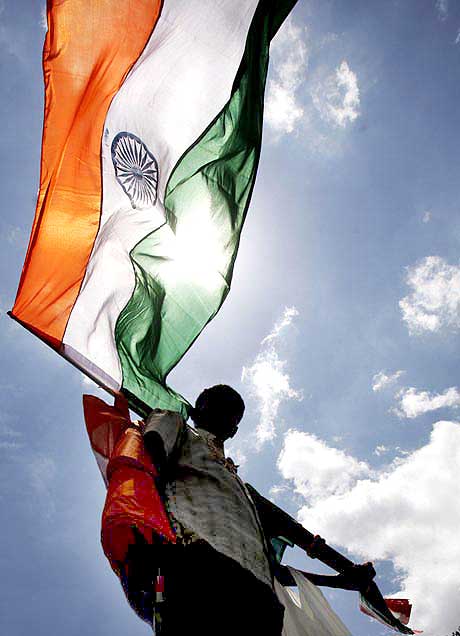
How has the Indian State, in principle and practice, given shape to the essential ingredients of the secular principle and composite culture?

Dear Friend is for those who idealised Dil Chahta Hai all out of proportion, and then warmed up to the premise that friendship could be a lot more complicated, and transient, observes Sreehari Nair.

Here are some of the reactions to the Supreme Court verdict on Ayodhya.

'The idea is to have a place where people can come together and bridge the gap. It will be a contemporary design for the future, and not have the shadows of the past' Ritwik Sharma reports.
Women activists urged the government to withdraw the Bill from consideration in the Rajya Sabha, and review the fundamental flaws pending broad-based community consultations.

As the campaign peaked, AAP leaders evidently realised they had to deflect their chief opponent's attempts to polarise the electorate over religious identity, explains David Devadas.

Medical experts feel an aggressive containment strategy in red zones and insulation of green zones is a must while giving relaxations.

Authorities across states have identified more than 6,000 people who attended the Nizamuddin Tablighi Jamaat congregation, the biggest COVID-19 hotspot in India.

Why starve while fasting when you can feast on these nutritious goodies?
Ahead of CJI Dipak Misra's final day as the head of the judiciary of India, here's a look at the key judgments that he was a part of.

'Collateral damage during operations needs to be avoided.' 'Such an objective can be achieved more easily should stone throwers not gear up to en masse oppose security forces.' 'With the conditions being quite sensitive at this stage, the death of one of these boys could easily serve the terrorists in instigating violence,' notes Brigadier S K Chatterji (retd).

'... That they should emerge as role-models to be emulated by the fellow countrymen; and that the middle classes should not stick only to hate-filled and scornful criticism and condemnation against the state of affairs,' remembers Mohammad Sajjad.
The bench questioned as to how the belief of Hindu worshippers can be challenged with regard to existence of 'janmasthan' and said the "sanctity of belief" that Lord Ram took birth there and whether it was genuine or "frivolous" can only be tested under Hinduism.
Today, it is modish to be part of a yoga class, to post stories on Instagram while striking an impressively complex asana in a bralette and crop-top paired with neon yoga pants, to bond over green tea and yoga bars after a strenuous session at the studio and have subscriptions to yoga studios, not ashrams, says Manavi Kapur.

On Sunday morning Eastern US time, four astronauts will zoom into space on a SpaceX Falcon 9 rocket from the Kennedy Space Centre in Florida. Commanding the spaceflight is Raja Chari, a United States Air Force colonel.

'It was a result of a fundamental Jewish value of kindness and concern.' 'A value that extends beyond our own and on the premise that when we are ok, we are supposed to look up and look around to see who is not.' 'And do something about it.'

'Respect the pledges you have made to the people of Kashmir.' 'Jammu and Kashmir is not like any other state of the country.'

Sasikala's letter to the prime minister on the issue comes days after Chief Minister O Panneerselvam urged the Centre to promulgate an ordinance for the conduct of the sport.

Indian politics, held captive in one way or the other by Ayodhya, may now well seek its emancipation from this issue, and the pursuit of welfare, asserts Congress leader Salman Khurshid in this excerpt from his latest book, Sunrise over Ayodhya.
The Supreme Court on Friday allowed Bharatiya Janata Party leader Subramanian Swamy to intervene in the pending matters relating to the Ayodhya title dispute with his plea seeking construction of Ram temple at the site of demolished disputed structure.

Regional economic integration in South Asia, he said, is a priority for the EU.

US Congressman Joe Crowley, who spearheaded the campaign for the Federal Bureau of Investigation to create a new separate hate crimes category in the agency's uniform crime reporting programme to track bigoted attacks against Sikh Americans, has now set his sights on fully integrating Sikh Americans in the US Armed Forces

Aseem Chhabra lists his favourite films, most of them shown at international film festivals held virtually (Berlinale and Rotterdam), hybrid (Toronto) or physical (Cannes and Venice).
'Of course, I would like a world in which candidates don't ask for my vote on religious (etc) grounds.' 'But will we ever live in a world free of such appeals?' 'More important, will a Supreme Court verdict, by itself, ever deliver such a world?' asks Dilip D'Souza.

'The Vision of Justice was indeed attained in the courtroom.' 'Not once, but multiple times.' 'But has it translated into reality?' 'Has the success of these sterling verdicts reached the ground?' asks Justice Ranjan Gogoi, the next Chief Justice of India.

Religion is but one trait where intolerance manifests itself. We come across 'chosen' races, communities, political ideologies, economic systems, all lending themselves to discriminatory arrangements, which trample the rights of those considered beyond the pale of whatever is the favoured calling.

As Kerala gets into the festive mood, police are maintaining tight vigil with the army receiving information that there may be a terror attack in southern parts of the country.

By pegging the exact area of the Babri Masjid site at 0.313 acres, and not the original 2.77 acres, the government hopes to be in line with the court ruling in the 1994 Ismail Faruqui case which mentions return of land to original claimants once the exact area needed for acquisition is determined, observes Saisuresh Sivaswamy.

It was truly heartening to see how the Sikh community had risen to the occasion during the Black Lives Matter peaceful protests and the coronavirus pandemic and selflessly served those looking for nourishment.

Justice Ranjan Gogoi, who will demit office as the Chief Justice of India in a week's time, has etched his name in the annals of history by giving finality to one of the most politically and religiously sensitive cases, the Ayodhya land dispute, which dates back to even before the Supreme Court came into existence in 1950.

For India to endorse Nepal's Buddhist conference will be like sipping from a poisoned chalice, warns former RA&W official Jayadeva Ranade.

United States President Donald Trump's controversial immigration order on Wednesday faced intense scrutiny as a court of appeals grilled the Trump Administration whether the travel ban unconstitutionally discriminates against Muslims and questioned the arguments that curbs were motivated by national security concerns.

Stalin has given due respect to seniority in the pecking order, but has also taken into consideration the demands of individual ministries and the suitability of individuals, observes N Sathiya Moorthy.
If democracy is to survive and thrive, duties have to be as important as rights and tolerance must be the foundation of public and private life.

When the bench asked Sibal 'shouldn't we hear the matter', he replied, 'Yes. You shouldn't.'

The BJP knows the CAA, combined with a fresh nationwide NRC process, is an idea that's dead on arrival. Where it lives on is as a divisive, polarising instrument as its rivals have to take a position against it and thereby be exposed to the charge of 'Muslim appeasement' again, points out Shekhar Gupta.

'Loss of faith in the fairness of the system and the perception that one cannot expect justice are the first few steps to the slippery slope of anarchy,' warns Colonel Anil A Athale (retd).

'Is he one who defends individual liberty at all costs, or is he one who allows some give and take that recognises the primacy of the social contract, our coming together to live in a society?'

While Congress criticised the Bharatiya Janata Party-led government for being "insensitive", saying yoga, a great discipline of ancient India, does not belong to the saffron party, Janata Dal-United termed it as yet another attempt to "impose the communal agenda" on Indian masses.

'There is an observable difference between Nepalis and Lankans and the rest of us.' 'It would serve us well to understand where this difference comes from and, if it is something that is better in some way, how it is that we can access it,' says Aakar Patel.
